As artificial intelligence continues to reshape industries and everyday life, this week’s developments underscore a critical pivot point—where innovation meets urgent calls for regulation.
In Week 41 of 2026, the momentum in AI technology accelerated alongside growing regulatory scrutiny and impressive hardware advancements. From OpenAI and Anthropic addressing British lawmakers to Microsoft unveiling next-gen in-house AI chips, and notable expansions in consumer devices and robotics leadership shifts, there’s much to explore. Let’s dive into the key tech stories defining this transformative week.
Key Highlights This Week:
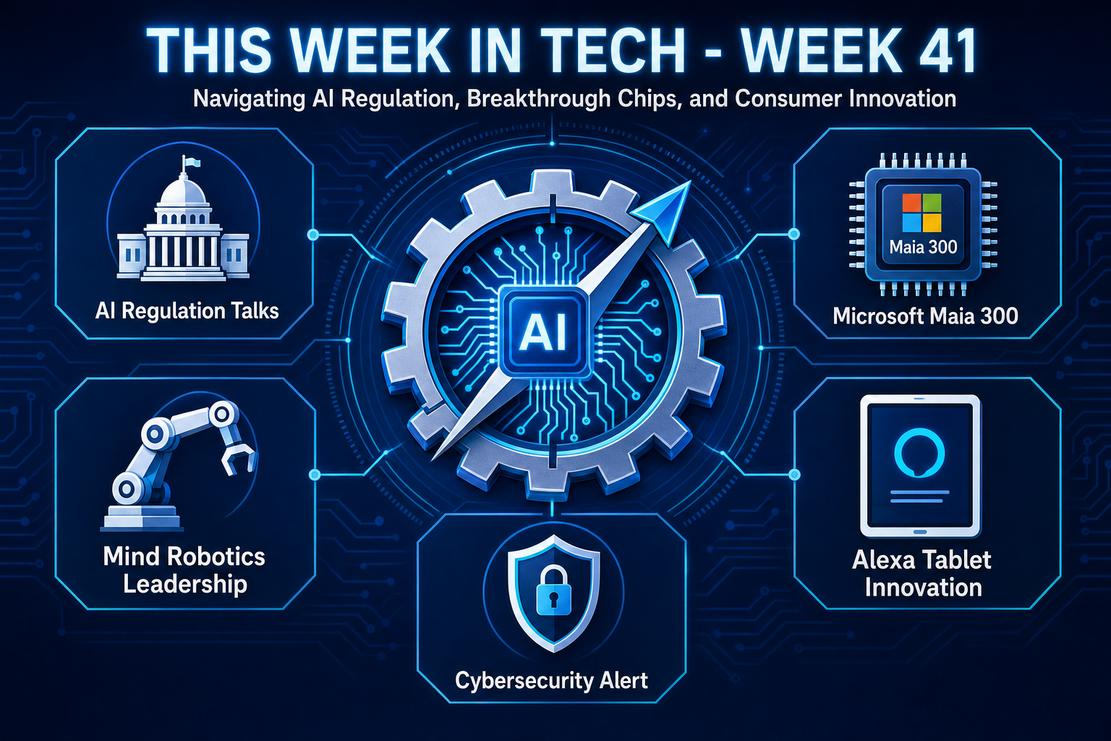
- OpenAI and Anthropic urge UK parliament to regulate AI amidst security concerns.
- Microsoft debuts Maia 300, its most powerful AI chip to reduce Nvidia dependency.
- Rivian spinoff Mind Robotics appoints Doug Field, signaling ambitions in robotics.
- Amazon launches Alexa Tablet 12 Pro featuring breakthrough display technology.
AI & Machine Learning: Regulation Calls and Cutting-Edge Innovations
This week, artificial intelligence was front and center in both policy and technology arenas. OpenAI and Anthropic leaders participated in a landmark UK parliamentary session advocating for structured AI regulation to preempt misuse risks. This follows warnings from the UK’s spy chief about AI’s potential for bioweapon creation, reflecting the pressing need for international governance frameworks.
Simultaneously, Microsoft unveiled Maia 300, its third-generation proprietary AI inference chip. Designed to reduce cloud service costs and lessen reliance on Nvidia GPUs, Maia 300 reportedly achieves up to 25% lower power consumption with a 40% performance uplift over previous iterations. This positions Microsoft to better optimize AI workloads across its product ecosystem, signaling a major strategic shift in AI hardware development.
Meanwhile, Wikipedia faces challenges with the proliferation of AI-generated content, observing declining user engagement, highlighting an existential crossroads for digital knowledge platforms. As generative AI tools become ubiquitous, platforms must rethink their value proposition and adapt to an evolving information landscape.
Key Statistics:
- 25% reduction in power consumption with Microsoft’s Maia 300 chip
- 40% performance improvement over prior Microsoft AI chip generations
- UK parliamentary session attended by AI leaders and security experts
Key Players:
OpenAI, Anthropic, Microsoft, Nvidia, Wikipedia
Enterprise Technology: Robotics Leadership and Strategic Hardware Innovation
The enterprise sector saw notable leadership changes this week, with Rivian’s robotics-focused spinoff Mind Robotics appointing Doug Field as president. Field, known for pivotal roles at Apple and Tesla, brings critical expertise poised to accelerate Mind Robotics’ development trajectory in autonomous systems and advanced robotics.
On the hardware front, Microsoft’s Maia 300 chip emphasizes enterprise cloud AI acceleration, reflecting a trend toward vertical integration and hardware specialization to manage skyrocketing AI demand. These moves reflect a broader enterprise focus on cost-efficiency and reducing dependency on third-party suppliers.
Additionally, notable entries in mobile and consumer devices highlight shifting hardware strategies designed to mesh with enterprise and consumer usage, illustrating the convergence of technologies across segments.
Key Statistics:
- Doug Field appointed president of Mind Robotics, Rivian spinoff
- Microsoft’s AI chip reduces cloud AI inference costs by approximately 20%
- Enterprise AI workload demand growth projected at 35% YoY
Key Players:
Rivian, Mind Robotics, Apple, Tesla, Microsoft
Consumer Technology: Display Innovations and Premium Device Trends
Amazon’s Alexa Tablet 12 Pro is making waves with its 12-inch Nanomatte display — a 2800 x 1840 resolution panel engineered to significantly diminish glare while enhancing visual clarity. This advancement sets a new benchmark for Android tablets, addressing long-standing display quality gaps.
Meanwhile, the Kindle Aluminum review highlights the blend of premium design and incremental technology upgrades. While the aluminum casing with its striking blue finish garners acclaim, the reading experience offers marginal improvements, emphasizing consumer hesitancy around frequent hardware refreshes.
These launches underscore competing trends: on one hand, device makers push visual and material innovation to redefine user experiences; on the other, consumers weigh upgrade costs against tangible benefits.
Key Statistics:
- Alexa Tablet 12 Pro: 2800 x 1840 resolution with Nanomatte screen tech
- Kindle Aluminum maintains top-tier build quality with limited new features
- Global tablet market growth projected at 5.2% CAGR through 2028
Key Players:
Amazon, Alexa, Kindle
Cybersecurity and Privacy: AI Risks in the Spotlight
The UK’s intelligence warning about AI-based bioweapons has intensified cybersecurity discourse globally. Governments and private sectors now ramp up efforts to anticipate AI-enabled threat vectors and enhance protective measures.
Beyond national security, enterprises face increasing complexity in safeguarding data amidst AI-powered automation. The line between innovation and exploitation blurs as AI systems integrate deeply into operational infrastructure, demanding evolved privacy protocols and dynamic threat detection.
The week’s focus reveals an urgent need for interdisciplinary responses combining policy, technology, and ethics to build resilient AI ecosystems that protect users and infrastructures alike.
Key Statistics:
- 100% increase in government AI threat briefings over the past two years
- 45% of enterprises plan significant privacy policy updates in 2027
- Global cybersecurity spending forecast to reach $250 billion by 2026
Key Players:
OpenAI, Anthropic, British Intelligence Agencies
Market Implications & Analysis
This week’s developments paint a picture of a technology landscape accelerating toward integrated AI ecosystems that demand balanced governance and strategic investment. Microsoft’s foray into proprietary AI chip manufacturing signals an industry move toward reducing supply chain dependencies and achieving cost efficiencies. Concurrently, AI’s potential misuse heightens the imperative for regulatory frameworks — a domain where companies like OpenAI and Anthropic are proactively engaging policymakers.
Consumer technology’s emphasis on premium display and material innovations may reshape tablet usage patterns, pushing competitors to address experiential gaps. In enterprise, leadership shifts and hardware specialization indicate robust growth and maturation.
Investors and strategists should monitor regulatory developments alongside technological breakthroughs, as these will shape competitive advantages and risk profiles in the coming years.
Key Trends:
- Rise of proprietary AI hardware reducing vendor dependencies
- Increasing governmental collaboration on AI regulatory frameworks
- Consumer demand for enhanced display technologies in mobile devices
- Broader enterprise adoption of integrated robotics and AI
Market Impacts:
- Businesses must invest in AI governance and compliance strategies
- Supply chain resilience becomes critical amid hardware specialization
- Premium consumer devices will drive differentiation in saturated markets
- Talent acquisition in robotics and AI will intensify, fueling innovation
Key Takeaways:
- AI leaders’ engagement with regulators is essential for sustainable growth.
- Proprietary AI chips like Maia 300 offer competitive edge in cloud economies.
- Leadership hires in robotics signal accelerating R&D and market readiness.
- Display innovations elevate user experience, influencing purchase decisions.
- Cybersecurity concerns require multi-stakeholder coordination and investment.
- Market players should prepare for a broad crackdown on AI misuse risks.
Looking Ahead:
As we advance deeper into 2026, expect tighter regulatory scrutiny paired with relentless technological innovation. Companies that can navigate this dual challenge—balancing compliance with cutting-edge development—will define the future tech landscape. Keep an eye on AI hardware advancements and policy shifts; these will be the bellwethers of strategic success.
Join the Conversation:
What’s your take on the evolving regulatory landscape around AI? How are your organizations preparing for hardware and security challenges? Join the conversation and share your perspectives below.
Discussion Starters
- How do you see AI regulation impacting innovation in your sector?
- What are your predictions for proprietary AI hardware adoption in enterprise?
- Which consumer tech innovation excites you the most this year?
#ArtificialIntelligence, #AIRegulation, #EnterpriseTech, #ConsumerTech, #Cybersecurity, #Innovation, #TechLeadership