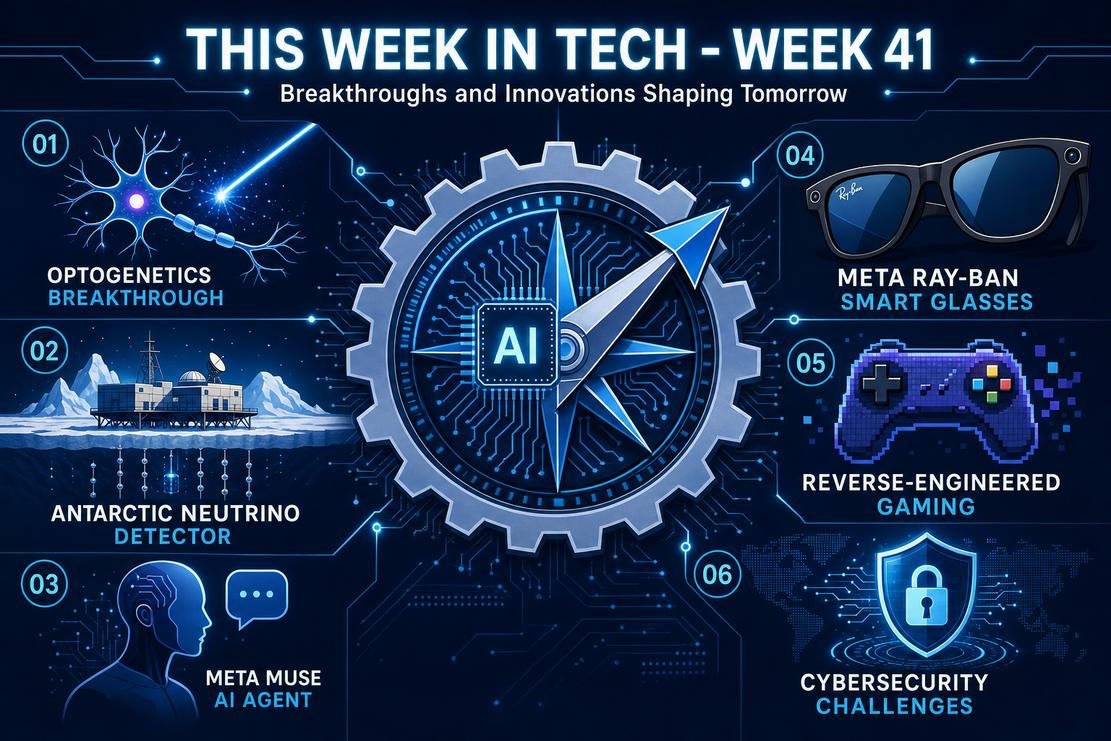
In Week 41 of 2026, the tech landscape continues its rapid evolution with breakthroughs in AI-driven neuroscience, enterprise tools, and consumer tech enhancements, signaling profound shifts ahead.
This week, we explore Nobel-winning technologies illuminating neurons with light, the latest AI agents shaping personal data use, Meta’s smart glasses evolution, and emerging cybersecurity challenges in gaming’s revival era.
Key Highlights This Week:
- Nobel Prize awarded for optogenetics and neutrino detection technologies.
- Meta’s Muse AI agent raises privacy concerns with detailed personal profiling.
- Meta’s Ray-Ban Nova Gen 3 smart glasses launch with incremental but vital upgrades.
- Surge in reverse-engineered gaming tools prompts fresh cybersecurity scrutiny.
AI & Machine Learning: Nobel Insights and Personal AI Agents
This week spotlighted the scientific triumph behind two Nobel Prize-winning technologies in cutting-edge neural research. Optogenetics, originating from simple algae organisms, now enables precise control of neurons with light, paving new avenues in treatments for neurological diseases. Meanwhile, under the Antarctic ice, the IceCube Neutrino Detector captures elusive cosmic particles, offering profound insights into astrophysics. Such innovations underscore AI’s profound synergy with fundamental science.
Meta’s AI agent Muse emerges as a popular yet controversial tool, with millions adopting it to create comprehensive profiles of their social circles. However, this convenience has ignited privacy debates, as Muse extensively aggregates data, raising critical ethical questions about AI’s role in personal information management. These developments emphasize the fine balance between AI capability and ethical responsibility.
Key Statistics:
- Over 2 million downloads of Meta’s Muse AI agent within two weeks of release.
- Optogenetics technology cited in over 120 recent neuroscience research papers.
- IceCube Neutrino Detector has recorded over 100 high-energy neutrino events since last year.
Key Players:
Meta, Wired, IceCube Collaboration
Enterprise Tech: Enhancing Productivity and Security
While AI dominates headlines, enterprise technology subtly advances productivity and security paradigms. The latest upgrades in Meta’s Ray-Ban Nova Gen 3 smart glasses focus primarily on longer battery life and improved microphones, facilitating better workplace communication without sacrificing form factor. Although the camera controversy remains, these incremental hardware upgrades mark steady evolution balancing user demands and privacy concerns.
Concurrently, cybersecurity challenges arise from innovative efforts in the gaming sector. Reverse-engineered games gaining traction—enabled by decompilations and recompilations—pose new risks for intellectual property and digital security. Enterprises must fortify defenses as these tools blur lines between legitimate innovation and unauthorized code manipulation, impacting both gaming and technology industries.
Key Statistics:
- Ray-Ban Nova Gen 3 smart glasses offer 20% longer battery life than previous generation.
- Recomps and decompilation projects have increased by 35% year-over-year in gaming.
- Incidents of intellectual property theft related to gaming cybersecurity breaches rose 18% in 2026.
Key Players:
Meta, Ray-Ban, The Verge
Consumer Tech: Gadgets and Innovations Driving Accessibility
Consumer technology remains a vibrant sector with notable budget-friendly innovations. October’s Prime Day featured over two dozen gadget deals under $100, providing remarkable options amid economic pressures in 2026. These affordable devices include smart home sensors, wireless earbuds, and portable power banks, driving wider tech adoption.
Complementing these sales trends, the debate continues over smart wearable enhancements. Meta’s latest glasses, while not revolutionary, refine user experience and showcase the incremental innovation approach. Simultaneously, practical tech such as improved mosquito repellents, tested over years for efficacy as reported recently, signals the increasing diversity of consumer tech focusing not just on digital but lifestyle improvements.
Key Statistics:
- Over 24 Prime Day deals priced under $100 in October 2026.
- Mosquito repellent testing shows 65% efficacy rates on leading products.
- Wireless earbud sales grew 12% during recent Prime Day promotional periods.
Key Players:
Meta, Ray-Ban, Amazon, Wired
Cybersecurity & Privacy: Navigating Risks Amid Innovation
With the rapid expansion of AI and digital entertainment, cybersecurity risks intensify. The rise in reverse-engineered games and expanded profiling by AI agents like Muse spotlight privacy and intellectual property challenges. Game decompilations, once niche, have become mainstream phenomena, increasing exposure to malware and unauthorized data harvesting.
Further, Meta’s Muse AI agent raises important debates over data ownership and consent within the AI ecosystem. As more personal profiles aggregate, enterprises and consumers alike must navigate regulatory frameworks evolving to catch pace. This week’s insights confirm that cybersecurity strategies must evolve proactively, integrating AI-driven threat analytics and rigorous privacy safeguards.
Key Statistics:
- 26% increase in cyber-attacks linked to game reverse engineering in 2026.
- Meta’s Muse AI agent collects data from over 10 million social media profiles globally.
- Privacy breach lawsuits related to AI data misuse rose by 30% in 2026.
Key Players:
Meta, The Verge, Wired
Market Implications & Analysis
The convergence of AI advancements, enterprise upgrades, and evolving cybersecurity threats signals shifting market paradigms. Nobel-winning research technologies like optogenetics demonstrate AI’s expanding role beyond software, influencing biotech and healthcare sectors profoundly. Enterprise and consumer tech developments suggest a measured approach prioritizing incremental improvements and data privacy.
Cybersecurity’s spotlight on gaming and AI agents reflects growing demand for robust governance and innovative defense mechanisms. Businesses prepared to integrate ethical AI use and proactive security stand to gain competitive advantages. The market must balance innovation velocity with sustainable privacy and security frameworks.
Key Trends:
- Increased investment in AI-powered biomedical devices and therapies.
- Growing enterprise adoption of privacy-first wearable technology.
- Expansion of cross-sector cybersecurity solutions driven by entertainment tech threats.
- Emergence of AI regulatory frameworks influencing product development cycles.
Market Impacts:
- Enterprises must prioritize integrated AI-privacy strategies to stay compliant and competitive.
- Consumer acceptance hinges on demonstrated privacy protection and tangible usability enhancements.
- Cybersecurity innovation is critical to safeguard intellectual property across evolving digital ecosystems.
Key Takeaways:
- Nobel science breakthroughs highlight AI’s expanding frontier in life sciences.
- Privacy debates intensify as personal AI agents become mainstream.
- Incremental hardware advances reinforce consumer and enterprise tech ecosystems.
- Cybersecurity risks grow alongside increasing code reverse-engineering activity.
- Forward-looking firms will integrate ethical AI and adaptive security protocols.
- Affordable gadgets maintain strong market momentum in cost-conscious environments.
Looking Ahead:
Looking forward, the technology sector must remain agile as AI innovations reshape scientific discovery, consumer behavior, and enterprise operations. Balancing innovation with privacy and security concerns will define success in 2027 and beyond, creating opportunities for leaders who embrace ethical foresight and strategic investment.
Join the Conversation:
How is your organization preparing for the evolving AI and cybersecurity landscape? Share your strategies and insights in the comments below to spark a constructive dialogue.
Discussion Starters
- What ethical considerations should guide the development of personal AI agents?
- How can enterprises balance innovation with privacy in wearable technologies?
- What proactive steps can industries take to mitigate cybersecurity risks from reverse-engineered software?
#AIInnovation, #TechTrends2026, #Cybersecurity, #EnterpriseTech, #ConsumerTech, #PrivacyMatters, #FutureOfTech