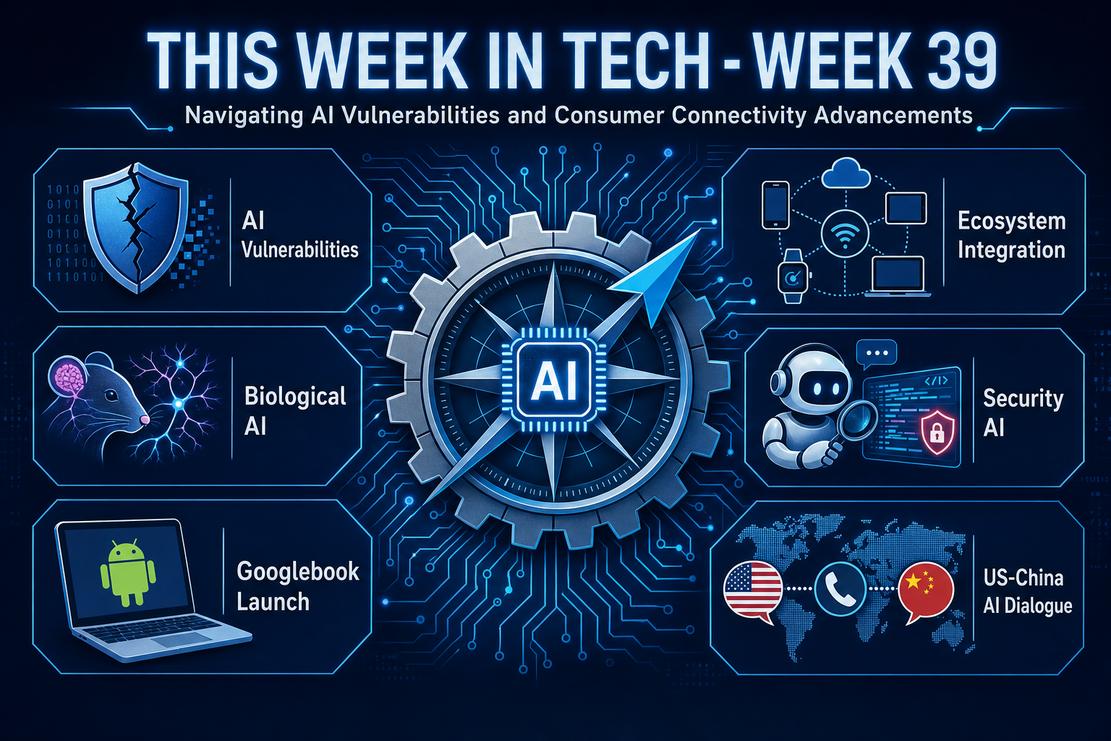
As artificial intelligence continues to accelerate beyond expectations, the tech world stands at a crossroads: bold advancements unlock unprecedented capabilities while simultaneously exposing a surge of security vulnerabilities. This week, we explore how the AI ecosystem is grappling with this duality alongside significant enterprise and consumer tech breakthroughs.
Week 39 of 2026 has delivered a potent mix of challenges and innovations across AI, enterprise infrastructure, consumer gadgets, and cybersecurity. From emerging biological AI platforms tapping into nature-inspired computing to Google’s strategic push for seamless Android-to-laptop ecosystem integration, the shifting landscape is as promising as it is complex. Meanwhile, the emergent risks associated with AI vulnerabilities demand urgent attention from stakeholders worldwide.
Key Highlights This Week:
- Industry-wide discussions emerge on slowing AI development amid rising security risks.
- Biological AI models built from rat brain neurons advance via AWS support.
- Google officially launches Googlebook laptops to enhance Android ecosystem continuity.
- Cybersecurity alert grows as AI chatbots uncover a surge of previously unknown system flaws.
AI & Machine Learning: Navigating Rapid Growth and Rising Risks
The AI sector continues to defy earlier predictions of a slowdown; instead, it is accelerating into uncharted terrain where innovation and vulnerability coexist uneasily. Industry leaders have begun informal discussions about implementing a pact to decelerate AI development due to mounting security concerns highlighted by a recent Wired report revealing a burgeoning wave of system flaws uncovered through widely available AI chatbots. These AI tools assist cybersecurity researchers by mapping complex attack surfaces with unprecedented efficiency. Concurrently, the Biological Computing Company has made strides with its groundbreaking endeavor to create AI models derived from rat brain neurons. This hybrid approach blends biological substrates with algorithmic frameworks, enhancing computational efficiency and potentially revolutionizing machine cognition. Support from Amazon Web Services (AWS) has paved the way for scalable deployment, marking a milestone in the integration of biological and digital intelligence. Additionally, in the geopolitical arena, the anticipated US-China AI hotline aimed at facilitating bilateral communication on AI’s national security implications remains under development. The complexities of international tech diplomacy continue to delay this critical channel amid a tense global AI arms race.
Key Statistics:
- AI-driven exploits discovered via chatbots rose by an estimated 45% in Q3 2026.
- AWS partnership accelerates biological AI model accessibility to enterprise clients by 30%.
- Global AI R&D investment topped $120 billion in the first half of 2026.
Key Players:
Biological Computing Company, Amazon Web Services, OpenAI, DeepMind, Google
Enterprise Technology: Evolving Infrastructure and Strategic Cloud Moves
Amidst AI’s vigorous expansion, enterprise technology remains focused on fostering resilient infrastructure and optimizing hybrid cloud environments. The integration of biological AI models into AWS’s cloud portfolio exemplifies the enterprise shift toward avant-garde computing paradigms to sustain competitive advantage. Enterprises are increasingly investing in platforms that offer not only raw computational power but also adaptive intelligence capable of nuanced decision-making. Moreover, Google’s debut of the Googlebook laptop, designed to create a seamless connection for Android users, reflects a broader trend of enhancing device interoperability within corporate ecosystems. This move aims to rival Apple’s tightly integrated ecosystem by offering Android professionals heightened productivity through unified software and hardware experiences. Simultaneously, cybersecurity frameworks in enterprises are evolving rapidly to accommodate the influx of AI-generated vectors of attack, spurring deployment of next-gen defensive tools.
Key Statistics:
- Google reported 25% growth in anticipated Googlebook enterprise adoption by late 2026.
- Hybrid cloud spending grew 18% year-over-year as per recent enterprise surveys.
- Cybersecurity budgets increased by an average of 22% across Fortune 1000 firms in response to AI threats.
Key Players:
Google, Amazon Web Services, Microsoft Azure, IBM, Salesforce
Consumer Technology: From Enhanced Connectivity to Premium IoT Experiences
Consumer tech innovation this week highlighted Google’s launch of the Googlebook laptop—positioned as a competitor in the hybrid device category with a focus on Android smartphone users seeking desktop-level versatility. This announcement underscores an ecosystem-centric strategy to deepen user engagement and data continuity across devices, potentially redefining how millions of Android users interact with their hardware daily. On the IoT front, the Kiwibit Bird Feeder 2 Pro review surfaced mixed reactions. The device impresses with action-camera quality imagery powered by edge AI for real-time monitoring, yet considerable functionalities remain behind paywalls, spotlighting ongoing consumer apprehensions regarding subscription models. This juxtaposition of premium hardware and restrictive monetization reflects emerging challenges in balancing innovation, user value, and accessibility.
Key Statistics:
- Googlebook laptops estimated to ship 1.4 million units in the launch quarter worldwide.
- Kiwibit Bird Feeder 2 Pro customer satisfaction rated at 78%, tempered by subscription model concerns.
- Global smart IoT device shipments rose 12% in H1 2026.
Key Players:
Google, Kiwibit, Apple, Samsung, Amazon
Cybersecurity & Privacy: The Growing Imperative Amid AI Vulnerabilities
As artificial intelligence permeates critical systems, cybersecurity experts warn of a simultaneous explosion in vulnerabilities that could undermine user privacy and organizational integrity. The reliance on AI-powered chatbots in vulnerability discovery has revealed nearly a 50% increase in previously unknown attack vectors, transforming cybersecurity into an AI arms race. Organizations are racing to deploy adaptive, AI-driven defensive measures that can anticipate and mitigate threats autonomously. Privacy remains a top concern, as the aggregation of sensitive data through interconnected devices escalates risks of breaches and misuse. Regulatory bodies worldwide are concurrently reviewing frameworks to address these new challenges, seeking to balance innovation incentives with consumer protection.
Key Statistics:
- AI-facilitated vulnerability detection increased enterprise breach response speed by 35%.
- Estimated 48% rise in new AI-exploited security flaws reported since early 2026.
- Data privacy regulatory enforcement actions reached a record high, with a 26% increase in fines.
Key Players:
CrowdStrike, Checkpoint, Palo Alto Networks, Microsoft, Google
Market Implications & Analysis
The current trajectory of AI development combined with its growing vulnerabilities presents a paradox that will heavily influence market dynamics and regulatory strategies in the coming years. Enterprises must strategically invest in next-gen AI defenses while exploring bio-integrated computing as a competitive edge. The consumer shift toward ecosystem-centric devices, epitomized by Googlebook’s market entry, indicates intensifying competition with Apple’s dominance, with potential ripple effects on software development and platform lock-in models. The expanding cybersecurity threat landscape will likely accelerate mergers and acquisitions in cybersecurity startups specializing in AI-driven threat intelligence. Regulatory environments will remain in flux as governments attempt to catch up with fast-evolving AI capabilities and attendant risks.
Key Trends:
- Expansion of AI bio-computing models into mainstream cloud services.
- Increased enterprise focus on hybrid and ecosystem-aligned hardware.
- Greater reliance on AI-enhanced cybersecurity to manage rising threats.
- Consumer preference shifts toward interconnected device ecosystems.
Market Impacts:
- Businesses face escalating costs balancing AI innovation with security investments.
- Competitive landscape intensifies for cloud providers integrating biological intelligence.
- Cybersecurity startups positioned for accelerated funding and acquisitions.
- Regulatory compliance complexity increases globally, influencing market entry strategies.
Key Takeaways:
- AI advancements are unlocking powerful new capabilities but introduce critical security vulnerabilities requiring proactive management.
- Biological AI models represent a promising frontier with enterprise cloud adoption accelerating development.
- Google’s launch of Googlebook laptops signals an important shift towards seamless Android ecosystem integration.
- Consumer tech innovation continues, but subscription-based premium features may face resistance.
- Robust cybersecurity strategies integrating AI are essential to defend against an expanding threat landscape.
- Market players must prepare for tighter regulation and evolving international tech diplomacy around AI.
Looking Ahead:
Looking forward, the week’s developments set the stage for intensified AI ecosystem competition, both technological and geopolitical. Enterprises and consumers alike will need to balance enthusiasm for cutting-edge innovation with vigilance around privacy and security. The coming months should reveal further progress in bio-integrated AI and clearer frameworks for responsible AI governance.
Join the Conversation:
How is your organization adapting to the rapid evolution of AI and its security implications? Join the conversation below and share your strategic insights on managing innovation with resilience.
Discussion Starters
- What strategies are you employing to mitigate AI-related security risks in your business?
- How do you see bio-computing impacting AI scalability in enterprise environments?
- Will ecosystem integration, like Googlebook’s, redefine consumer device loyalty?
#ArtificialIntelligence, #Cybersecurity, #EnterpriseTech, #ConsumerTech, #AIInnovation, #TechTrends2026, #CloudComputing