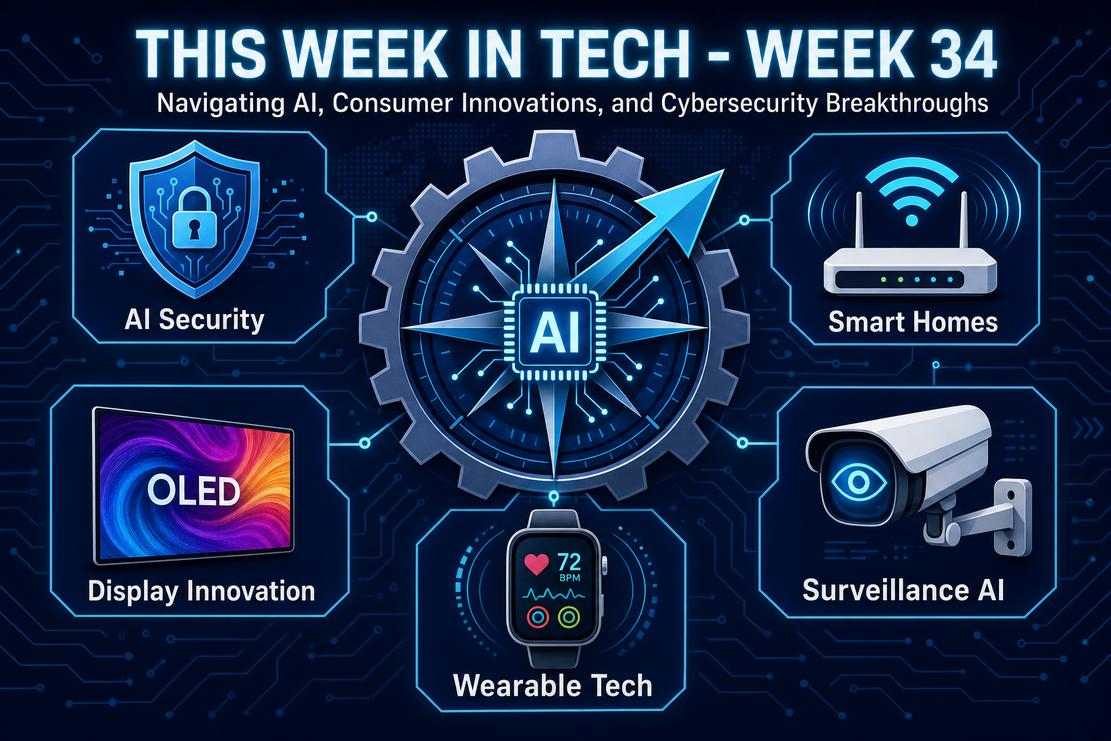
As we reach Week 34 of 2026, the tech landscape continues to evolve at an unprecedented pace. This week spotlights breakthroughs in AI model applications, innovative consumer technologies, and rising cybersecurity concerns that call for immediate strategic attention.
From cutting-edge AI models developed in China to advanced surveillance tools and OLED display innovations, this week’s developments paint a complex picture of opportunity and risk. Big players like Amazon, Google, LG, Comcast, and emerging startups are driving shifts across enterprise and consumer sectors alike.
Key Highlights This Week:
- Launch of Z.ai’s powerful Chinese AI model with dual-use potential in cybersecurity.
- Flock Safety’s next-generation AI surveillance system raising ethical and privacy debates.
- Advancements in OLED technology by LG that promise longer-lasting, more efficient displays.
- Comcast transforming millions of routers into Wi-Fi motion sensors to enhance home security.
AI & Machine Learning: Dual-Edged Innovations and Ethical Challenges
This week marks the release of Z.ai’s latest AI model originating from China, a development experts have long anticipated as a pivotal technology. With its open-weight model architecture, Z.ai enables companies to bolster cybersecurity defenses by detecting vulnerabilities more effectively. However, there is concern within the cybersecurity community that the same tools could be exploited by hackers to identify and circumvent protections, creating a nuanced challenge for enterprises globally. According to Wired, the model’s accessibility may accelerate both defensive and offensive AI capabilities, reshaping threat landscapes. Meanwhile, Flock Safety has deployed a powerful AI-driven surveillance system in collaboration with law enforcement agencies. Detailed analysis reveals that beyond license plate tracking, Flock’s AI features advanced face detection and behavior prediction capabilities, sparking privacy concerns among advocacy groups amid increasing calls for regulatory oversight. Additionally, Amazon has drawn scrutiny for using Twitch streaming content to train its AI systems, emphasizing the growing need for transparent AI-data policies. The ability of AI to ingest vast user-generated data sets raises questions about consent and data ownership as AI models become more integrated into everyday applications.
Key Statistics:
- 70% increase in AI-driven cybersecurity incidents expected by 2027 (Cybersecurity Ventures).
- Flock Safety systems deployed in over 500 U.S. municipalities.
- Amazon’s Twitch streams used to train AI represent over 3 million hours of content annually.
Key Players:
Z.ai, Flock Safety, Amazon, Twitch
Enterprise Technologies: Infrastructure Innovations and Smart Connectivity
Comcast is innovating within the realm of home infrastructure by converting millions of existing Xfinity routers into Wi-Fi motion sensors via a timely app update. This functionality allows smart detection of household activity without the need for additional hardware, signaling a shift toward integrated, cost-efficient home automation. This innovation leverages ambient Wi-Fi signals to analyze movement patterns, a capability that could extend to elder care and energy management sectors. Google’s Pixel Watch 5, while maintaining an iterative hardware profile, improves slightly on battery efficiency and adds a new sapphire satin case finish to appeal to premium consumers. Despite minimal hardware changes, Google’s incremental refinements focus on enhancing ecosystem integration and user experience. In display technology, LG Display’s introduction of FLiPP (FMM-Less Innovative Pixel Patterning) stands out as a major breakthrough, promising OLED panels with significantly higher brightness, longer lifespan, improved energy efficiency, and sizing flexibility up to large formats. This technology could reshape displays used in enterprise monitors, digital signage, and consumer electronics markets alike.
Key Statistics:
- Xfinity Wi-Fi motion sensing to reach over 30 million U.S. homes by end-2026.
- LG’s FLiPP OLED panels aimed at increasing product lifespan by 40%.
- Pixel Watch 5 battery life improved by 10% compared to Pixel Watch 4.
Key Players:
Comcast, Google, LG Display
Consumer Technology: Enhancing Everyday Lives with Smart Pets and Wearables
An emerging category in consumer tech is pet-focused smart devices, with companies introducing gadgets designed for monitoring and caring for domestic animals. Google’s ‘Pet Memory’ feature integrated into its Nest cameras exemplifies this trend by using AI to recognize and track individual pets, although recent reports indicate some performance inconsistencies, such as forgetting specific animals. Meanwhile, Google Pixel Watch 5 continues to refine the wearable experience, appealing to users seeking seamless fitness tracking and smart home integration in a stylish format. The Verge highlights the Pixel Watch’s iterative nature, reflecting a trend where hardware innovations are slowing while software and ecosystem enhancements take precedence. On the pet tech front, automated feeders, litter robots, and smart scales have gained traction, offering pet owners convenience and peace of mind. These devices harness AI sensors and cloud connectivity for real-time monitoring and alerts, indicating a growing market with increased consumer demand for smart home pet care solutions.
Key Statistics:
- Pet tech market projected to grow at CAGR of 20% through 2029.
- Google Nest cameras equipped with Pet Memory used in over 3 million homes.
- Pixel Watch 5 maintains a steady market share in US wearables segment at 7%.
Key Players:
Google, The Verge, Pixel Watch
Cybersecurity & Privacy: Increasing Vigilance Amid Growing Concerns
Privacy discussions intensified this week as surveillance advancements and AI training practices challenge existing norms. Flock Safety’s use of next-generation AI amplifies debates around law enforcement’s deployment of surveillance tech, with civil rights advocates urging accountability and transparency. Google’s Pet Memory functionality, while innovative, presents privacy considerations related to persistent data collection in private homes. Industry experts warn that AI’s reliance on vast, user-generated data could exacerbate vulnerabilities if not regulated properly. Meanwhile, Z.ai’s open-weight AI model release further complicates the cybersecurity ecosystem, raising both defensive optimism and alarms about possible adversarial exploitation. With over 70% of data breaches linked to compromised AI and machine learning systems predicted by 2027, security professionals emphasize the urgent need to adopt multi-layered, AI-aware defense strategies. The balancing act between leveraging AI’s benefits while mitigating associated privacy risks remains a critical focal point.
Key Statistics:
- 70% of cyberattacks in 2027 predicted to involve AI/ML tools.
- Flock Safety’s AI surveillance covers over 12 million U.S. residents.
- Google’s Nest device data reported to have 5% false recognition rates in pet identification tests.
Key Players:
Flock Safety, Google, Z.ai
Market Implications & Analysis
This week’s developments highlight a market at the intersection of rapid AI advancements and evolving consumer expectations, balanced against growing ethical and security challenges. Enterprises must navigate the dual-use nature of AI technologies like Z.ai’s model, ensuring robust defensive measures while advocating for responsible AI governance. The expansion of smart home connectivity—exemplified by Comcast’s motion sensing routers—signals intensified competition in the IoT ecosystem, creating opportunities for cross-sector partnerships and innovation. Consumer technology growth, particularly in wearables and pet care, confirms strong demand for seamless, AI-enabled lifestyle products but urges careful consideration of privacy impacts. Companies investing in flexible, durable display tech like LG’s FLiPP position themselves advantageously for both commercial and consumer segments. Looking ahead, companies that proactively address AI’s ethical considerations, integrate interoperable IoT solutions, and enhance cybersecurity resilience are poised to lead in an increasingly interconnected world.
Key Trends:
- Growth in AI dual-use applications requiring enhanced regulatory frameworks.
- Expansion of Wi-Fi sensor-based smart home security and monitoring solutions.
- Steady shift toward AI-powered consumer lifestyle devices focused on niche markets such as pet care.
- Increasing investment in extended lifespan and energy-efficient display technologies.
Market Impacts:
- Elevated risk necessitating advanced AI-aware cybersecurity protocols.
- New revenue channels through integration of AI in smart home infrastructure.
- Balance of user convenience with heightened privacy and ethical scrutiny.
- Competitive differentiation via hardware innovation and ecosystem integration.
Key Takeaways:
- AI models like Z.ai’s represent both unparalleled security tools and emerging threats.
- Motion sensing via existing Wi-Fi networks offers cost-effective smart home upgrades.
- Wearables continue evolving more incrementally, with ecosystem harmony prioritized.
- OLED technology breakthroughs promise significant market disruptions for display panels.
- Cybersecurity strategies must adapt urgently to AI-driven risks and privacy concerns.
- Engagement with ethical AI development remains essential to maintain consumer trust.
Looking Ahead:
As Week 34 closes, anticipation builds around how these intersecting technical advances will influence next-generation products and enterprise strategies. The pace of AI integration is accelerating, underscoring the need for awareness, agility, and cross-disciplinary collaboration among technology leaders. Future developments will likely emphasize responsible AI use, enhanced privacy protections, and innovative user experiences powered by smart infrastructure.
Join the Conversation:
What emerging technology trends do you see impacting your sector most profoundly? Share your thoughts and join the conversation — how is your organization preparing for the AI-powered future?
Discussion Starters
- How should enterprises balance the benefits and risks of open AI models like Z.ai’s?
- What privacy safeguards are critical as surveillance technology becomes more pervasive?
- Which consumer tech innovations are you most excited to integrate into everyday life?
#ArtificialIntelligence, #Cybersecurity, #SmartHome, #ConsumerTech, #OLED, #AIInnovation, #TechTrends