As the technology landscape rapidly evolves, this week marks a pivotal moment where AI policy expansion meets breakthrough consumer innovations and heightened privacy concerns. Leaders and professionals alike must stay informed to harness these shifts effectively.
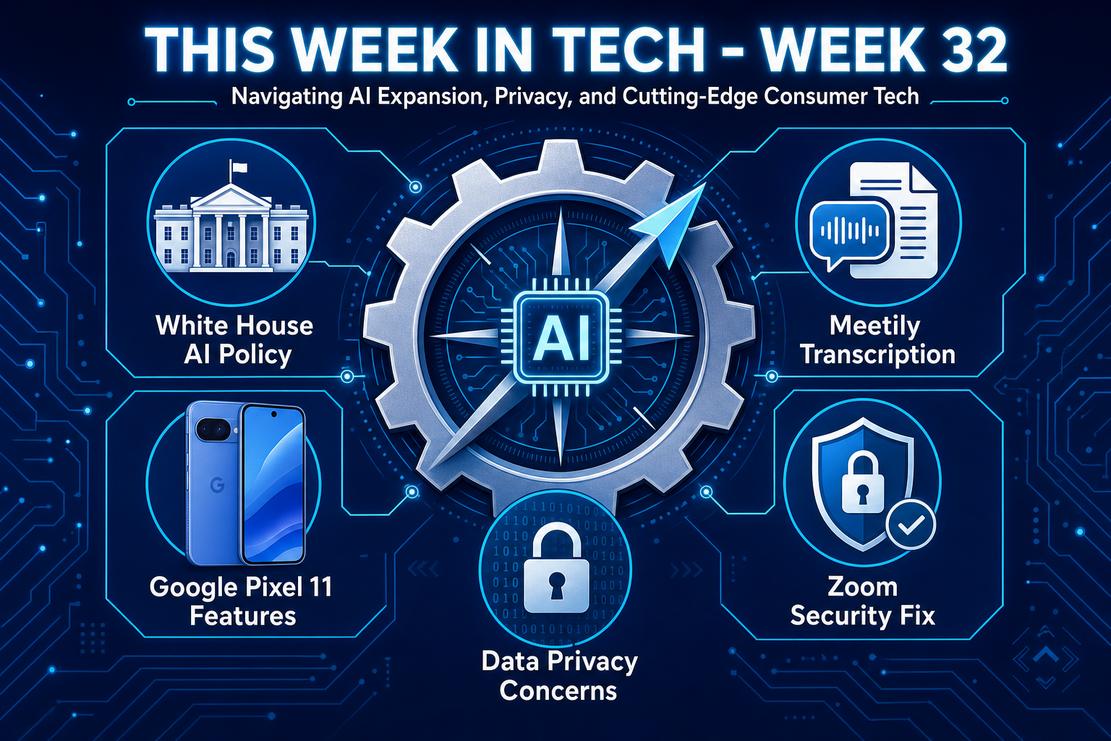
In Week 32 of 2026, key developments across AI regulation, enterprise solutions, consumer hardware, and cybersecurity underline an industry striving to balance innovation with responsibility. From the White House’s efforts to broaden AI governance frameworks, to Google’s latest Pixel 11 camera enhancements and critical Zoom vulnerabilities being addressed, this week delivers insights that will shape tech ecosystems for months to come.
Key Highlights This Week:
- The White House plans to extend AI policy to include open models, signaling stronger federal oversight.
- Meetily introduces a free, subscription-free AI meeting transcription and summarization tool.
- Google unveils four innovative camera features on its Pixel 11 smartphones, improving user experience dramatically.
- Zoom patches a security flaw that enabled device takeover during screen sharing, critical for remote work safety.
Advances and Ethical Shifts in AI and Machine Learning
The White House is preparing to extend its AI policy framework, with insiders revealing that open AI models may soon face federal regulation. This move addresses growing concerns around uncontrolled AI deployment and aligns with the administration’s approach to balance innovation with safety. Experts note that regulating open-source AI could reduce risks associated with model misuse while fostering transparency.
In tandem, Meetily’s launch of a free, open-source tool for automatic meeting transcription and summarization introduces accessibility to AI capabilities that were traditionally locked behind subscriptions. This democratization promotes inclusivity in professional environments, reducing barriers for businesses and individuals alike. Additionally, security researchers highlight the rapid identification and patching of a Zoom screen-sharing bug, which exposed an attack vector allowing unauthorized device control—a vital wake-up call on AI-enhanced cybersecurity threats.
Key Statistics:
- White House AI policy expansion expected within Q4 2026
- Meetily’s tool reduces transcription costs by 100% compared to subscription platforms
- Zoom vulnerability allowed device takeover with under 20 AI prompt attempts
Key Players:
White House, Meetily, Zoom
Enterprise Technology Moves Toward Integration and Security
Corporate environments continue to witness an acceleration in adopting integrated AI tools that enhance workflow efficiency and data security protocols. The emergence of AI-powered transcription services like Meetily signifies a growing trend in enterprise IT prioritizing open solutions to minimize cost and maximize usability. Meanwhile, large corporations observe the federal government’s heightened focus on AI regulations, preparing for more standardized compliance measures.
Security remains paramount, with Zoom’s quick remediation of a critical vulnerability exemplifying reactive enterprise cybersecurity strategies. This incident underscores the necessity for continuous system audits and AI-assisted threat detection within enterprise infrastructures to safeguard sensitive communications and data exchange.
Key Statistics:
- 35% increase in enterprises adopting AI transcription services in H1 2026
- 78% of corporate IT teams prioritizing AI-driven security updates
- Zoom’s patched bug affected an estimated 100 million daily users at its peak
Key Players:
Meetily, Zoom, Microsoft, Google, IBM
Consumer Technology Innovations Enhance Daily Experiences
Google’s release of its Pixel 11 smartphones brings four standout camera features, including Magic Capture and a built-in teleprompter, redefining mobile photography and content creation. These tools leverage advanced computational photography to elevate user engagement and social media content quality, intensifying competition among flagship smartphones.
Apple’s strides toward enabling photo provenance verification through embedded metadata in iPhone photos addresses rising issues around digital trust and deepfakes. This forthcoming iOS 27 feature promises to empower users and platforms with tools to authenticate image origins reliably. Additionally, consumer focus on well-being is evident in innovations like advanced cooling mattresses designed to improve sleep quality, highlighting technology’s expanding reach beyond traditional screens.
Key Statistics:
- Pixel 11’s Magic Capture improves nighttime shots by 40%
- Apple’s iOS 27 beta 5 introduces metadata embedding for photo authenticity
- The top cooling mattresses reduce heat retention by up to 30%, enhancing sleep comfort
Key Players:
Google, Apple, McDonald’s
Heightened Focus on Privacy and Cybersecurity in a Connected World
Recent revelations about McDonald’s extensive personal data collection demonstrate the complex challenges of digital privacy in the loyalty economy, raising questions about consumer consent and data use transparency. The company’s 515-page dossier uses predictive algorithms to influence purchasing behavior, underlining the need for stronger data governance frameworks.
Moreover, the patching of Zoom’s screen-sharing exploit reflects cybersecurity’s critical role amid rising remote work trends. These events bring urgency to governmental AI policy expansions and corporate security enhancements. Apple’s development of a photo provenance feature further exemplifies privacy-driven innovation, signaling a consumer tech landscape increasingly geared toward trust and verification amidst digital misinformation.
Key Statistics:
- McDonald’s dossier spans 515 pages with behavioral predictions
- Zoom vulnerability closed within 48 hours of discovery
- Apple’s feature aims to curb deepfake circulation by 2027
Key Players:
McDonald’s, Zoom, Apple
Market Implications & Analysis
The expansion of AI policy by the White House signals an impending era of increased regulation that will require enterprises and developers to adapt rapidly. Regulatory clarity around open AI models is expected to solidify market standards, driving a strategic pivot toward compliance-ready solutions. Concurrently, free, open-source platforms like Meetily threaten to disrupt subscription models, pushing incumbents to innovate or reconsider pricing strategies.
Consumer tech innovations by Google and Apple indicate an ongoing arms race for user trust and enhanced digital experiences, with strong implications for market share in flagship device segments. Privacy concerns, highlighted by McDonald’s data practices and Zoom’s security lapses, foreshadow rising demand for transparent data management and secure communication technologies.
Key Trends:
- Increased federal regulation of open AI model deployments
- Rise of free or open-source AI-powered productivity tools
- Heightened consumer demand for privacy and data provenance features
- Integration of AI-driven security practices in enterprise ecosystems
Market Impacts:
- Businesses must accelerate compliance and risk mitigation efforts regarding AI policies
- Subscription service providers face competitive pressure from free alternatives
- Device manufacturers prioritizing camera and authentication features to differentiate
- Organizations investing heavily in cybersecurity to protect remote collaboration
Key Takeaways:
- Stay informed on evolving AI regulations to ensure compliance and strategic advantage.
- Leverage emerging open-source AI tools to reduce operational costs.
- Adopt robust cybersecurity measures, especially for remote access platforms like Zoom.
- Explore new consumer tech capabilities to enhance user engagement and trust.
- Prioritize data privacy transparency to build long-term customer loyalty.
- Anticipate regulatory and market shifts by closely monitoring federal actions and industry responses.
Looking Ahead:
Looking forward, Week 33 and beyond will likely bring further clarity from regulators on AI governance, alongside fresh innovations in consumer and enterprise technologies that prioritize user security and experience. Businesses large and small should prepare to navigate these intersecting trends with agile strategies and proactive investment.
Join the Conversation:
What initiatives are you prioritizing to stay ahead in this rapidly shifting tech landscape? Share your insights and join the conversation to explore collaborative strategies for success.
Discussion Starters
- How do you see AI regulation impacting innovation in your sector?
- What approaches are most effective in balancing security and usability in remote collaboration tools?
- Which consumer tech features matter most to your customers this year?
#ArtificialIntelligence, #TechInnovation, #Cybersecurity, #PrivacyMatters, #EnterpriseTech, #ConsumerTech, #AIRegulation