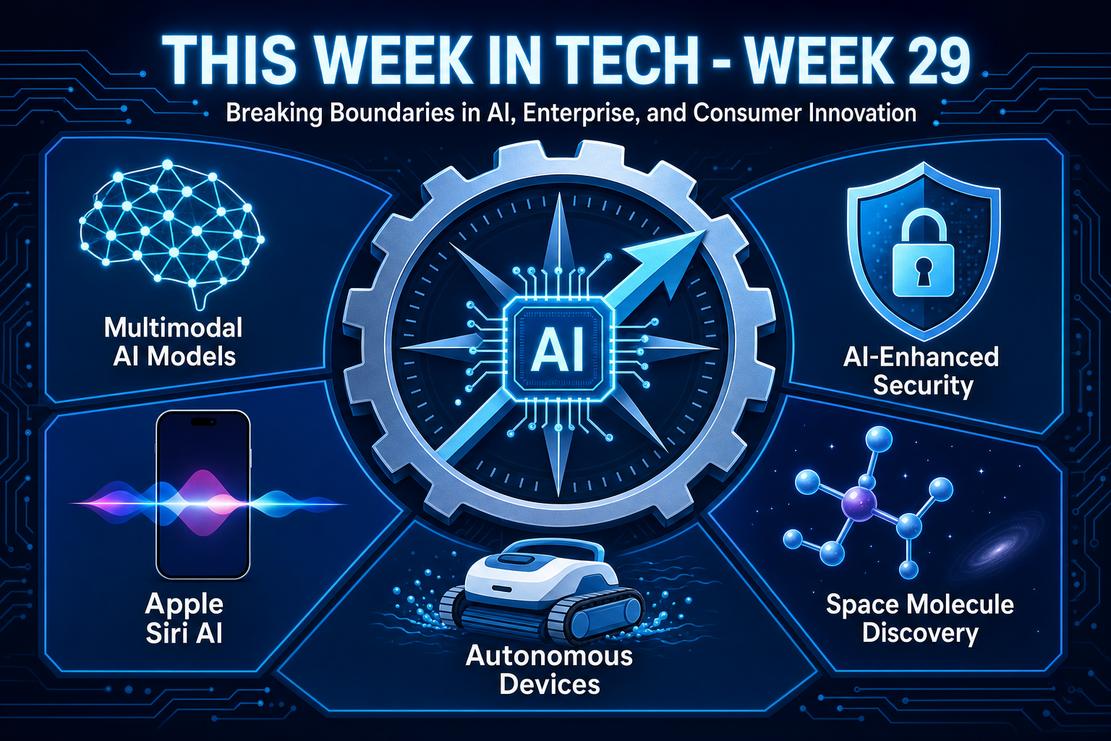
As we close in on the final months of 2025, the technology landscape is rapidly evolving, shaped by bold investments in AI infrastructure and innovative consumer devices that promise to reshape user interaction. This week, major players are driving advancements not just through breakthroughs in machine learning but by redefining how we connect, work, and safeguard digital spaces.
This Week in Tech explores the profound impact of AI data center expansions on the US economy, Apple’s strategic partnership with Google Gemini AI, landmark legal rulings affecting AI art, and breakthroughs in cancer treatments leveraging light-based technologies. We will also delve into the latest gaming innovations, disappearing security challenges like captcha, and the debut of cloud streaming on PlayStation Portal, offering a panoramic view of technological progress shaping our world.
Key Highlights This Week:
- Microsoft, Amazon, Meta, and Alphabet invest tens of billions in AI data center infrastructure fueling economic growth
- Apple signs a $1 billion annual deal with Google to power Siri with a custom Gemini AI model
- Stability AI wins legal battle against Getty Images, signaling uncertainty in AI training data copyright law
- PlayStation Portal launches official cloud streaming for Premium Plus members, revolutionizing portable gaming
AI and Machine Learning: Infrastructure, Innovation, and Legal Landscape
The explosion of AI data centers across the United States spearheaded by Microsoft, Amazon, Meta, and Alphabet is reshaping not only the tech sector but the broader economy. Recent reports indicate these four giants have collectively invested over $60 billion into new facilities in 2025 alone, driving job creation and boosting regional development. This surge positions AI infrastructure as a critical growth engine alongside traditional industries, accounting for an estimated 1.4% increase in US GDP growth this year.
On the technology front, Apple’s strategic move to license Google’s Gemini AI with a custom integration marks a new phase in voice assistant capabilities. Paying as much as $1 billion per year, Apple aims to enhance Siri to meet rising consumer expectations for natural, context-aware interaction. This collaboration highlights a larger trend of tech titans converging on advanced AI ecosystems to maintain competitive edges.
Meanwhile, the legal domain is grappling with AI’s rapid evolution as demonstrated by Stability AI’s recent UK court victory over Getty Images. The ruling, which dismissed claims about the use of copyrighted images for AI training datasets, injects uncertainty into copyright protections and highlights the urgent need for updated regulatory frameworks globally.
Key Statistics:
- AI data center investments exceed $60B in 2025 by top US tech firms
- Apple’s annual payment to Google for Gemini AI access: ~$1 billion
- US GDP growth contribution from AI infrastructure estimated at 1.4%
Key Players:
Microsoft, Amazon, Meta, Alphabet, Apple, Google, Stability AI, Getty Images
Enterprise Technology: Cloud Streaming and the Future of Work
The enterprise tech sphere continues to be transformed by advancements in cloud computing and streaming. Sony’s PlayStation Portal recently launched official cloud streaming capabilities for PlayStation Premium Plus members, allowing access to an increasing catalog of PS5 titles without hardware limitations. This marks an important milestone for cloud-enabled gaming, showcasing how edge computing and high-bandwidth networks reduce latency to deliver seamless interactive experiences.
Beyond gaming, this technology evolution hints at a future where enterprises leverage similar cloud streaming infrastructures for business applications, remote collaboration, and digital twins, enhancing operational agility and reducing IT overhead. With global cloud spending projected to surpass $820 billion in 2025, these innovations underpin strategic shifts toward hybrid cloud ecosystems and more flexible software delivery models.
Key Statistics:
- PlayStation Portal cloud streaming launched in November 2025
- Global cloud spending forecast: $820B+ in 2025
- Latency improvements reduce response time in cloud gaming by up to 40%
Key Players:
Sony, PlayStation, Microsoft, Amazon Web Services, Google Cloud, IBM
Consumer Technology: Innovations in Devices and User Experience
This week saw fresh reviews and product launches that signal new directions in consumer tech design and functionality. Razer’s Blade 14 continues to lead the compact gaming laptop segment, now featuring an OLED screen and Nvidia’s latest RTX 40 series GPUs while slimming the chassis for portability. Analysts note it addresses user demand for powerful yet mobile devices aimed at on-the-go gamers and creative professionals alike.
Meanwhile, Aura’s new Ink digital photo frame leverages E Ink technology to deliver newspaper-like crispness with low power consumption and a fully wireless design. This device targets an underserved market segment seeking aesthetic sophistication combined with modern convenience.
On the mobile security front, captchas are quietly disappearing. Wired reports that traditional bot verification puzzles are being replaced by invisible, background AI and behavioral detection technologies, streamlining user experience and reducing friction during authentication.
Key Statistics:
- Razer Blade 14 latest model features OLED and Nvidia RTX 40 GPU
- Aura Ink boasts 30% lower power consumption than LCD-based frames
- Captcha challenges usage on websites down by approximately 55% over two years
Key Players:
Razer, Aura, Nvidia, Wired Media
Cybersecurity and Privacy: Evolving Safeguards in a Hyperconnected Era
With rapid adoption of AI and cloud streaming, cybersecurity challenges grow exponentially. The disappearance of traditional captchas is a double-edged sword: improved user convenience comes with reliance on sophisticated AI detection, which poses new privacy questions about behavioral data collection. Experts urge companies to balance these innovations with transparent data policies and robust encryption standards.
Recent cases such as Stability AI’s copyright victory emphasize privacy and intellectual property areas needing urgent clarification. Moreover, as AI models power more consumer and enterprise devices, data breach risks linked to unauthorized model training and data harvesting escalate. Security firms report a 28% rise in AI-targeted cyber attacks in 2025, pushing demand for next-gen threat detection using AI for AI defense.
Key Statistics:
- Captcha usage on web declined 55% in last 2 years
- AI-targeted cyberattacks increased 28% during 2025
- 80% of cybersecurity budgets now allocated toward AI-based defense
Key Players:
Stability AI, Getty Images, Google, Microsoft, Meta, Amazon
Market Implications & Analysis
The confluence of amplified AI infrastructure investment and emergent cloud technologies signals a pivotal transformation across sectors from consumer devices to enterprise IT and digital security. Companies that proactively integrate scalable AI models with robust cloud deployments stand to gain market leadership and improved operational resilience. However, legal and privacy uncertainties pose notable risks that could influence legislative reform and investor confidence.
Emerging trends underscore the shift toward AI-powered personalization, hybrid cloud solutions, and seamless, frictionless user experiences. Businesses must strategically balance innovation with compliance and data ethics to harness this momentum. Early adopters of integrated AI voice assistant ecosystems and cloud gaming platforms are establishing competitive moats amid fast-changing consumer expectations.
Key Trends:
- Widespread adoption of AI-customized voice assistants across consumer devices
- Cloud streaming extending beyond gaming into enterprise collaboration tools
- Legal frameworks for AI training datasets evolving rapidly worldwide
- Behavioral AI replacing traditional authentication methods
Market Impacts:
- Boost in US regional economies adjacent to new AI data centers
- Increased licensing revenues for AI model creators and cloud providers
- Heightened regulatory scrutiny around data privacy impacting product rollouts
- Shift in cybersecurity priorities toward AI-driven defense tools
Key Takeaways:
- Investment in AI data center infrastructure is a major economic growth driver
- Cross-company AI collaborations will redefine digital assistant capabilities
- The copyright and data privacy legal landscape is rapidly evolving
- Cloud streaming technology will transform both entertainment and enterprise sectors
- Consumer device innovation balances power and portability for end-users
- Cybersecurity must evolve dynamically as AI integration increases risk exposure
Looking Ahead:
As we move into 2026, technology stakeholders should prepare for tighter integration of AI across all layers of digital infrastructure, increased regulatory oversight, and novel user experience paradigms shaped by personalized AI and cloud services. Continuous innovation, combined with ethical governance and proactive security postures, will define success in this era of hyperconnectivity.
Join the Conversation:
What are the biggest challenges your organization faces in adopting AI infrastructure? How are you balancing innovation with privacy and security? Share your experiences and predictions in the comments below.