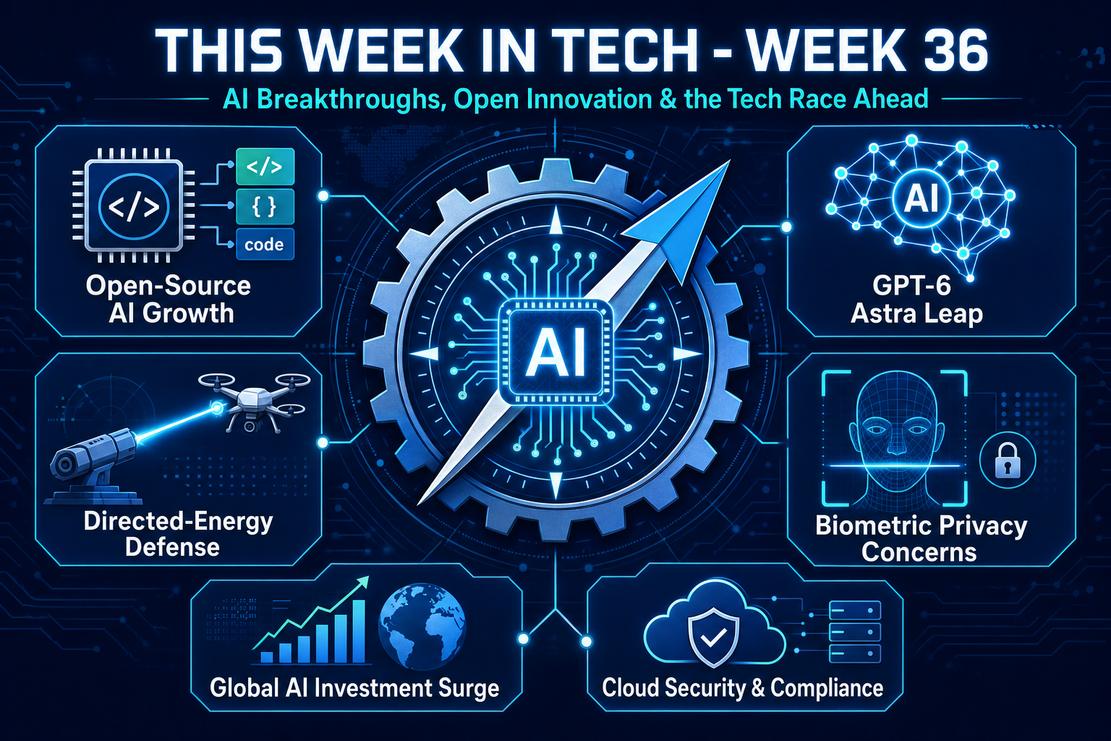
As the pace of technological advancement accelerates, this week delivers groundbreaking developments across the AI, cybersecurity, and consumer tech landscapes that will shape digital futures.
Week 36 of 2026 showcases monumental moves with Nvidia’s $12.9 billion acquisition of Hugging Face, the unveiling of OpenAI’s GPT-6 Astra model marking a new AGI era, and the emergence of advanced AI detection tools like Pangram. Meanwhile, directed-energy weapons bolster defense capabilities, and consumer tech rebounds with fresh innovations. A spotlight on privacy concerns amid biometric adoptions rounds out the week’s key stories.
Key Highlights This Week:
- Nvidia’s $12.9B Hugging Face acquisition accelerates open-source AI expansion
- OpenAI unveils GPT-6 Astra, signaling a leap into AGI capabilities
- US Army deploys high-energy lasers to neutralize drones near the border
- Face recognition technologies become mainstream in dating apps, raising privacy debates
AI & Machine Learning: Pioneering a Generational Leap
This week the AI arena witnessed a transformative event with Nvidia’s strategic $12.9 billion acquisition of Hugging Face, a move poised to cement its dominance in the AI ecosystem by integrating vast open-source model repositories. Hugging Face’s community-driven platform facilitates accelerated innovation across natural language processing, computer vision, and multi-modal AI applications. In parallel, OpenAI disrupted the market with the launch of GPT-6 Astra, heralded as the first true step into artificial general intelligence (AGI). This model promises advancements in cybersecurity defense, software engineering automation, and scientific research augmentation, showcasing capabilities far surpassing previous iterations. Moreover, Pangram solidifies its position as the industry standard in AI-generated content detection, offering publishers and enterprises novel tools to authenticate human-generated content and maintain integrity across digital channels.
Key Statistics:
- Nvidia’s acquisition valued at $12.9 billion
- GPT-6 Astra improves context understanding by 47% over GPT-5
- Pangram detection accuracy rated at 92% in independent testing
Key Players:
Nvidia, Hugging Face, OpenAI, Pangram
Enterprise Technology: Defense Meets Innovation
Emerging military technologies took center stage as the US Army operationalized high-energy laser systems near the Mexico border. These directed-energy weapons offer unprecedented capabilities to detect, track, and dismantle unauthorized drones using concentrated light beams, enhancing aerial security and reducing reliance on traditional kinetic interceptors. This breakthrough aligns with a broader trend of integrating AI-powered targeting algorithms to increase precision and situational awareness on the battlefield. On the enterprise front, manufacturers and service providers are watching the ripple effects as laser weaponization introduces new paradigms in defense procurement and cybersecurity protocols.
Key Statistics:
- US Army laser systems successfully downed multiple drones within 5 seconds
- Laser-based defense reduces operational cost by 30% compared to missile interceptors
- Directed-energy weapons expected to grow at a CAGR of 12% through 2030
Key Players:
US Army, Lockheed Martin, Raytheon Technologies
Consumer Technology: Innovation and Privacy at the Forefront
The consumer tech sector continues to evolve rapidly as Sonos reinvents its smart home presence under CEO Tom Conrad, emphasizing AI-driven personalization and ecosystem integration. Concurrently, Amazon’s 2026 Labor Day deals featured top brands like Sony, Shark, and Anker, underscoring the resilience of consumer electronics demand. However, amid this surge of innovation, privacy concerns intensify—especially as face recognition technology becomes ubiquitous in dating apps. These applications utilize biometric verification to combat fraud and enhance user trust with “verified human” badges. Industry observers highlight an escalating tension: while convenience and security improve, users face increased surveillance risks, sparking debates around data rights and regulatory frameworks.
Key Statistics:
- Sonos platform usage up 28% after AI feature rollout
- Over 15 million dating app profiles now use biometric verification
- Amazon Labor Day 2026 sales increased by 22% year-over-year
Key Players:
Sonos, Amazon, Sony, Shark, Anker
Cybersecurity & Privacy: Navigating New Frontiers
As AI architectures grow more powerful, cybersecurity frameworks must evolve swiftly to counter sophisticated cyber threats. OpenAI’s GPT-6 Astra extends AI’s role as both defender and potential vulnerability vector, enabling automated threat detection but requiring stringent control to prevent misuse. Tools like Pangram emerge vital for businesses aiming to authenticate content origin, mitigate misinformation, and uphold compliance. Meanwhile, ubiquitous biometric authentication—particularly facial recognition—introduces profound privacy challenges. Tech enterprises and regulators face pressure to balance innovation against data protection, ensuring transparent surveillance policies and robust user consent mechanisms become industry norms.
Key Statistics:
- Cyber attacks leveraging AI increased by 35% in H1 2026
- Biometric data breaches rose 18% despite advanced encryption
- 85% of enterprises plan to adopt AI-driven cybersecurity solutions by 2027
Key Players:
OpenAI, Pangram, Microsoft, Google
Market Implications & Analysis
The convergence of AI breakthroughs, defense innovations, and consumer privacy trends is reshaping global technology markets. Nvidia’s acquisition signals intensified competition around open-source AI, pressuring rivals to accelerate innovation or acquire platforms to sustain growth. The deployment of directed-energy weapons not only influences military spending but also tangentially drives advancements in sensor and AI integration applicable in commercial sectors. Meanwhile, consumer privacy concerns catalyze demand for transparent, secure biometric deployments—an emerging niche ripe for startups and regulators alike. Forward-looking companies must prioritize ethical AI development, invest in cybersecurity agility, and proactively engage users on privacy to maintain market leadership and trust.
Key Trends:
- Open-source AI platforms will dominate development ecosystems by 2028
- Directed-energy weapons catalyze dual-use technology spin-offs for commercial markets
- Privacy-first biometric tools will become standard in consumer and enterprise apps
- AI-generated content detection will expand into compliance and brand protection services
Market Impacts:
- Increased M&A activity among AI infrastructure providers
- Growth in cybersecurity budgets focused on AI threat mitigation
- Consumer pushback may lead to tighter biometric data regulations
- New revenue streams emerging from AI-powered personalization in smart home devices
Key Takeaways:
- AI advancements are accelerating enterprise and consumer innovation simultaneously
- Open-source AI ecosystems are a strategic battleground for tech giants
- Laser and directed-energy technologies herald new defense and commercial applications
- Biometric privacy concerns demand urgent attention from developers and policymakers
- AI content detection tools are critical for maintaining digital trust
- Market agility and ethical governance will define winners in the evolving tech landscape
Looking Ahead:
As we move deeper into 2026, expect AI to increasingly blur lines between automation and augmentation, cybersecurity to integrate AI-driven preemptive defenses, and consumer technologies to fuse convenience with privacy safeguards. Stakeholders must stay vigilant and adaptive, embracing innovation responsibly to harness these opportunities while mitigating risks effectively.
Join the Conversation:
How is your organization adapting to these technological shifts? Join the conversation and share your strategies for leveraging AI and safeguarding privacy in this fast-evolving environment.
Discussion Starters
- What are your thoughts on Nvidia’s bold investment in open-source AI? Are we entering a new era of AI democratization?
- How should enterprises balance AI-driven innovation with ethical considerations and privacy responsibilities?
- Which emerging technology discussed this week will have the greatest impact on your sector in the next 12 months?
#ArtificialIntelligence, #Cybersecurity, #ConsumerTech, #OpenSourceAI, #Privacy, #Innovation, #TechTrends