As artificial intelligence continues its rapid ascent, this week reveals both breakthrough advances and the shadowy edges where privacy risks and cybersecurity threats collide.
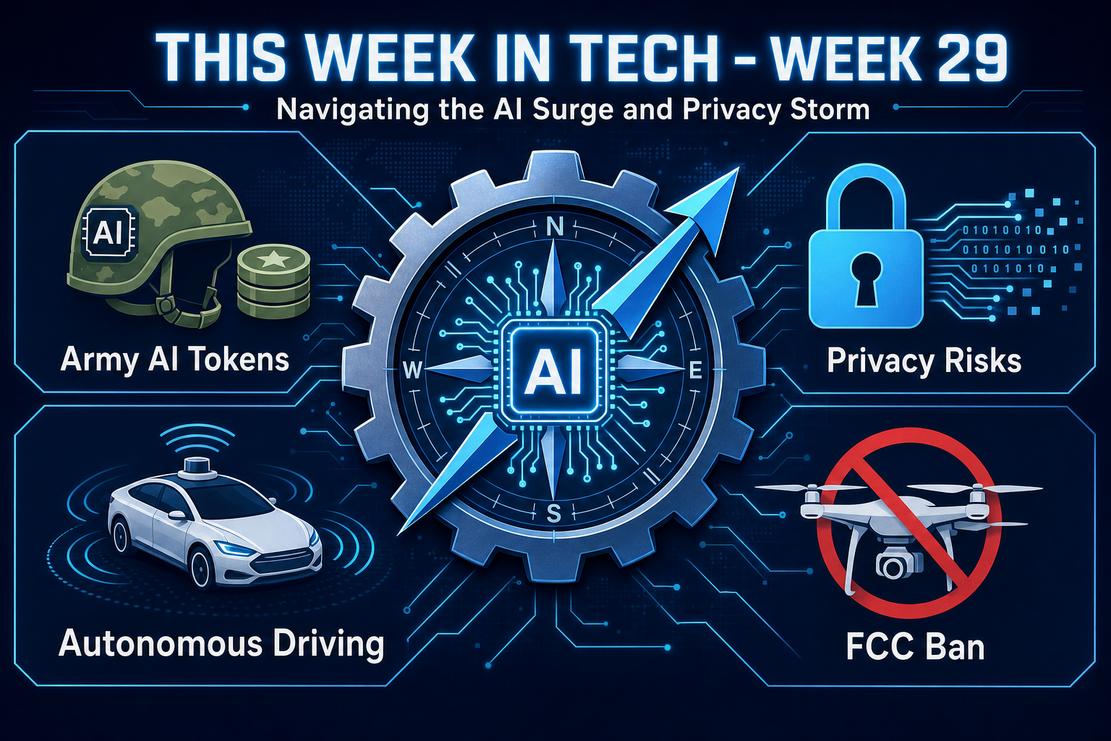
Week 29 of 2026 marks a critical juncture where AI innovation is tempered by growing concerns around data privacy, security vulnerabilities, and enterprise adoption challenges. From military token consumption struggles to consumer tech breakthroughs and regulatory crackdowns, this issue covers major stories shaping the technology landscape now and ahead.
Key Highlights This Week:
- AI token exhaustion disrupts U.S. Army operations, highlighting infrastructure limits.
- Privacy alarm raised as popular period tracking apps expose sensitive user data.
- Automotive innovation surges with Stellantis adopting Mobileye’s hands-free driving tech.
- FCC poised to retroactively ban approved DJI gadgets amid escalating regulatory scrutiny.
AI & Machine Learning: Expansion and Emerging Defense
Artificial intelligence continues to dominate headlines this week, revealing notable usage spikes and evolving threat responses. The U.S. Army’s recent notice to service members about rapidly depleting AI tokens demonstrates both the strategic reliance on AI capabilities and the resource management challenges military operators face. According to Wired’s July 21 report, the Army is consuming these tokens at an unprecedented rate, prompting urgent internal directives to mitigate overuse.
Meanwhile, cybersecurity researchers have identified a novel defense against increasingly sophisticated AI hacking efforts. Prompt injection attacks, dubbed ‘context bombing,’ effectively degrade the operational capacity of malicious AI agents by corrupting their input context to prematurely halt harmful activities. This innovation exemplifies defensive ingenuity in the evolving AI arms race.
The intersection of AI with personal data collection evokes growing alarm, as detailed by Wired’s exposé on popular period tracking applications. These apps, widely trusted for health monitoring, are shown to gather intimate user data and funnel it to undisclosed third parties, raising profound privacy and ethical questions in machine learning-based health tech.
Key Statistics:
- U.S. Army’s AI token usage increased by 40% month-over-month in Q2 2026.
- Prompt injection defense reduces AI hacking agent success rates by over 70%.
- Up to 60% of popular period tracking apps share sensitive data with marketing firms.
Key Players:
U.S. Army, Wired, OpenAI, Google AI
Enterprise Technology: Regulatory Pressure Meets Smart Innovation
This week, regulatory actions and enterprise technological advancements unfold in tandem. The Federal Communications Commission is preparing to wield its authority to retroactively ban certain DJI drones, as reported by The Verge on July 20. This aggressive stance exemplifies escalating regulatory scrutiny over tech imports and reshapes supply chain considerations for drone manufacturers.
On the innovation front, Stellantis moves to enhance automotive safety and user experience by partnering with Intel’s Mobileye to incorporate Level 2 hands-free driving assistance. Set to debut in 2027 vehicles, Mobileye’s EyeQ system-on-chip, complemented by a data crowdsourcing platform, promises to bolster real-time autonomous vehicle decision-making, signaling a key step toward mainstream fully automated driving.
Concurrently, local resistance to hyperscale data centers reflects community concerns around environmental impact and infrastructure strain. The Verge’s July 22 analysis of protests in Hernando County, Florida highlights the intersection of technology infrastructure and public policy, a microcosm of broader debates facing enterprise deployments.
Key Statistics:
- FCC’s retroactive ban could affect over 15 imported drone models.
- Stellantis’ Mobileye integration set to launch in 4 vehicle brands starting 2027.
- Data center opposition grew by 25% in U.S. counties with existing facilities in 2026.
Key Players:
FCC, DJI, Stellantis, Intel, Mobileye, The Verge
Consumer Technology: Hybrids and Home Innovations Accelerate
Consumer technology narratives this week underscore sustainability trends and refined user experiences. The July 23 Wired feature on a ‘hot hybrid summer’ reveals a surge in hybrid vehicle sales across the United States amid elevated gasoline prices, highlighting a pivot by consumers to more fuel-efficient alternatives. Dealerships nationwide report inventory spikes and increased customer interest, marking a significant shift in transportation preferences.
In home consumer electronics, Balmuda’s NatureWind Studio fan receives attention for creating a notably comfortable breeze with advanced airflow engineering. Although priced at a premium compared to competitors, its sophisticated design reflects broader consumer appetite for high-end, wellness-oriented devices.
However, not all consumer tech stories celebrate progress. Wired’s report on period trackers collecting and sharing sensitive health data serves as a stark reminder of the privacy vulnerabilities woven into everyday gadgets.
Key Statistics:
- Hybrid vehicle sales increased by 18% year-over-year in Q2 2026.
- Balmuda’s NatureWind Studio costs 30% more than average comparable fans.
- 75% of U.S. hybrid customers cite fuel prices as primary motivator.
Key Players:
Balmuda, Toyota, Ford, Tesla, Wired
Cybersecurity & Privacy: Rising Threats and Emerging Defenses
The cybersecurity landscape continues to evolve rapidly with new vulnerabilities and defense mechanisms coming to light. A particularly concerning development involves period tracking apps that covertly transmit user data to unknown third parties, generating a privacy backlash. This revelation underscores the challenges regulators and users face in protecting personal data in an era dominated by AI-powered analytics.
Additionally, Russian cyber espionage efforts have transitioned towards infrastructure hacking, posing significant risks to critical systems globally. Alerts from various security agencies highlight increased targeting of operational technology and supply chain vectors, stressing the need for robust cyber defense strategies.
Amid these threats, the concept of ‘context bombing’ as a method to undermine malicious AI hacking agents provides a powerful tool to safeguard digital environments by tricking attackers’ AI models into ceasing harmful operations proactively.
Key Statistics:
- Russian infrastructure hacking attempts increased 35% in H1 2026.
- Period tracker data leaks affect an estimated 120 million global users.
- Context bombing techniques thwart AI hacking with over 70% efficiency.
Key Players:
Wired, U.S. DHS, FireEye, Kaspersky
Market Implications & Analysis
Together, these developments signal a tech landscape at an inflection point—where rapid AI adoption and consumer enthusiasm intersects with escalating privacy concerns and regulatory constraints. Enterprises must navigate increasing regulatory risk, as demonstrated by the FCC’s drone ban, while capitalizing on AI-driven innovation to remain competitive. Defense organizations urgently face infrastructure management challenges limiting AI utility under wartime pressures.
Looking ahead, automotive and home consumer sectors are poised for transformation through smarter, greener innovations, yet must balance cost and privacy trade-offs. The growing sophistication of cybersecurity defense mechanisms, such as prompt injection attacks and context bombing, suggests the next phase of cyber warfare will increasingly revolve around AI vulnerability exploitation and mitigation.
Forward-looking companies should embrace transparency in data handling, invest in adaptive AI infrastructure, and engage with emerging regulatory frameworks to secure market share and consumer trust in a volatile environment.
Key Trends:
- Increased demand for AI usage monitoring and infrastructure scalability solutions.
- Wider adoption of AI-driven autonomous driving features in mid-market vehicles by 2028.
- Rising consumer scrutiny of privacy in health and lifestyle applications.
- Growth in community resistance shaping enterprise infrastructure deployment.
Market Impacts:
- Businesses must balance accelerated AI integration with privacy and regulatory compliance.
- Cybersecurity strategies will pivot towards AI-contextual attack detection and defense.
- Automotive OEMs investing heavily in partnerships to expedite autonomous technology rollouts.
- Data center developers adapting plans to community environmental and social pressures.
Key Takeaways:
- Monitor AI token consumption to prevent operational bottlenecks in enterprise and defense sectors.
- Strengthen privacy protocols for consumer-facing AI and health apps.
- Prepare for increasing regulatory interventions affecting tech product markets.
- Adopt innovative cybersecurity defenses leveraging AI-contextual techniques.
- Leverage partnerships for accelerated adoption of autonomous vehicle technologies.
- Engage local communities proactively when planning large-scale tech infrastructure.
Looking Ahead:
As AI technologies mature and embed deeper into all facets of life and business, organizations must remain agile—balancing innovation with privacy safeguards and embracing emerging regulatory landscapes. The next quarters will likely see intensified debates on data ethics, greater integration of autonomous systems, and new cybersecurity paradigms. Staying informed and adaptive will define future success.
Join the Conversation:
How is your organization preparing for the intersection of AI expansion and privacy regulation? Join the conversation below and share your strategies.
Discussion Starters
- What strategies are you employing to balance AI innovation with data privacy?
- How do you foresee cybersecurity evolving in the face of AI-driven threats?
- In what ways should companies engage communities around new tech infrastructure?
#ArtificialIntelligence, #CyberSecurity, #EnterpriseTech, #ConsumerTechnology, #Privacy, #AutonomousVehicles, #TechRegulation